
Feeding Elephants at an Ethical Sanctuary in Chiang Mai, Thailand

Chiang Mai is one of the best places to go if you want to spend time with Asian elephants. There are a ton of ethical elephant sanctuaries within about an hour's drive from the Old City, and many of the tour companies offer full-day combination tours so you can feed elephants, explore some pagodas, and enjoy a number of other natural attractions in the Khun Tan Mountain Range.
*No elephants were harmed in the making of this post*
Elephants are my favorite animal, so a trip to an ethical sanctuary was obviously at the very top of my list on a visit to Thailand. In case you haven't heard, riding elephants has fallen out of favor among locals and tourists alike. And rightly so - the practice relies on animal cruelty to "break" wild elephants, and the elephants face permanent injury as they are not anatomically built to carry heavy loads.
In lieu of this practice, sanctuaries have opened their doors to tourists to feed elephants, watch them bathe, walk through the forest with them, and the like. And honestly, I feel like this was better than riding one, although I've never done it so I can't say for certain. Instead of sitting on an elephant and looking at the back of its head, I was face to face with them and had my hands slobbered by their massively strong trunks.
Fun fact: An elephant trunk, or proboscis, has more than 40,000 muscles in it!! For reference, our entire bodies have fewer than 1,000. Their trunks can weigh up to 300 pounds and lift more than double that weight. And they can suck up to 3 gallons of water into their trunks before squirting it into their mouths, which is how they drink since the trunk's nostrils lead directly to the lungs (via the brain for smelling!).
Are Asian elephants different from African elephants?
There are three species of elephants still living today. The African Savannah elephant, also called the African bush elephant, is the biggest land animal on the planet. The African Forest elephant is the smallest of the three, with darker skin and straighter tusks. The Asian elephant, finally, is the most different of the three.
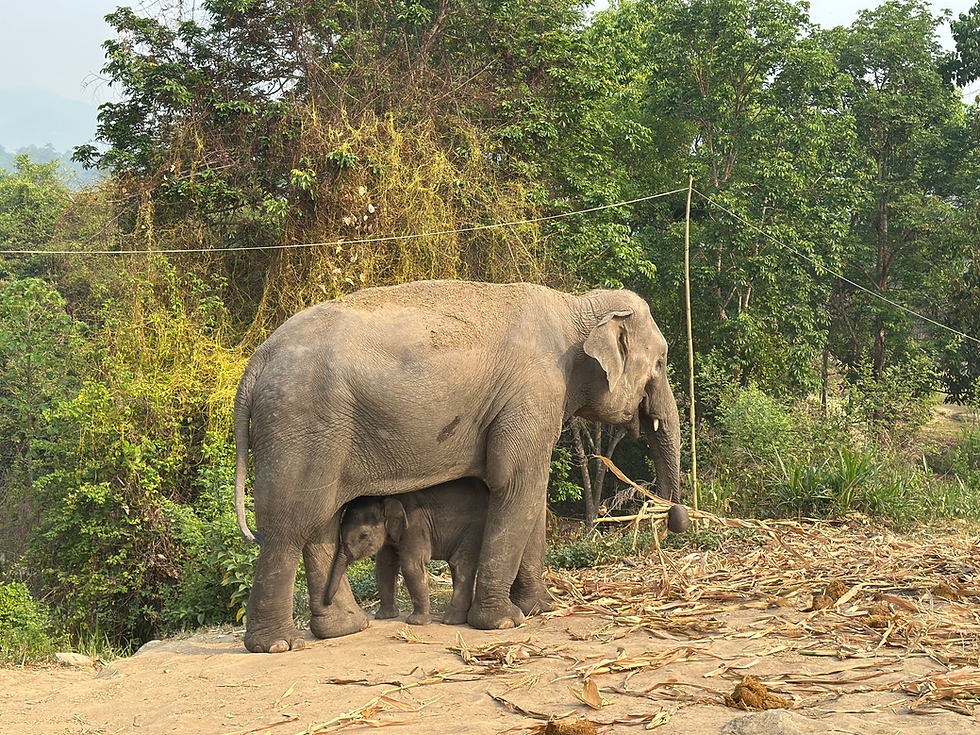
Asian elephants are in between size-wise, but they look a lot different in other ways. Asian elephants have smaller ears and larger heads, with protrusions on their forehead that look like a prominent eyebrow ridge (see the above photo on the left). While African elephants are usually gray, Asian elephants can be a bit browner and, as you can see with one of the elephants (in my above photo on the right), some Asian elephants tend to lose pigment as they age and develop spots on top of pink skin on their ears and foreheads. Also, since only male Asian elephants grow long tusks, you can see (in the middle photo below) that the two mother elephants we met both had very short tusks.
Best way to hang out with elephants in Thailand
We did a private tour that included feeding the elephants at the elephant sanctuary, hiking through rice paddies (which were all dried up for the summer), swimming below a waterfall, visiting the King and Queen Pagodas, and eating an amazing home-cooked meal featuring the local cuisine. This was an awesome full-day experience, and it was probably my favorite day of my whole trip to Thailand.
We started by driving an hour up the mountains southwest of Chiang Mai. This took us into the massively popular Doi Inthanon National Park, nicknamed the "Roof of Thailand" because it is home to the highest point in the country. The elephant sanctuary was our first stop on the tour. It was on the hillside above a river where the elephants like to bathe and cool down throughout the day. There was a fancy glamping situation right at the river - as nice as it was, you can see in my photo below that the bridge to cross the river itself was a sagging bundle of long bamboo - and then up on the hillside, a more modest pavilion-type structure with a hammock where the elephant handlers hang out. This wooden structure actually shook when the elephants got too rowdy, but it seemed sturdy enough.
We got to meet two mothers and two babies - one only four months old and one nearly a year old. The elephants were really playful and quite smart. They were fairly food-motivated and came right up to take sugar cane out of our hands. They ignored us once we ran out of sugar cane, but they continued listening to their handlers and followed when it was time to head up into the woods and then back down to the river. Once they were - extremely temporarily - full, we got to watch the babies play as the mothers continued eating and seemed to have only a passing interest in the babies.
Each mother elephant has its own handler, who forages for food with them, cleans up after them, and facilitates safe interactions with tourists. These are members of the local tribe, the Karen Hill tribe, which is Thailand's largest ethnic minority group. I really enjoyed seeing the relationships between the elephants and their handlers. They seemed very connected, and it seemed like the handlers always knew what the elephants were about to do.
Elephants are also known for having excellent memories and happily greeted our tour guide even though he hadn't seen them in weeks. I'm curious if they would remember me, having only spent a couple of hours together, if I went back years later... There's only one way to find out!
After feeding the elephants from the shelter, we walked up into the woods with them, where they like to forage a bit for themselves and scratch against the trees to get the insects off. We could see that a lot of trees in this area had smoother bark below a certain height from the wear and tear of the elephants. They also gathered brush and dirt to cover their backs, both to protect against insects and to keep them cooler in the direct sun.
After walking up the hillside, the elephants must have been hot because they took a dip in this extremely dirty puddle in front of the shelter. They use their trunks really effectively to cover themselves head to toe in the water, again for the same benefits as the dirt provides.
At the end of our visit, we made our way back down to the river so the elephants could cool down and finally rinse off. They really enjoy the water, and I loved seeing them dunk themselves and use their trunk as nature's snorkel to breathe - the baby elephant especially, since the river was a little deep for it in the middle.
After spending a couple of hours with these beautiful creatures, we drove to the trailhead for a waterfall hike. We hiked through a rice paddy, past a couple of waterfalls, and into a small village where we enjoyed freshly brewed coffee that had been grown on the mountain. I'll cover all that and the rest of this amazing day in my second post about the King and Queen Pagodas and the Summit of Thailand. Although, if I am being honest, as beautiful as those pagodas were, nothing will compare for me to hanging out with Asian elephants on a Thai hillside!


