Everything You'll See Hiking in Saguaro National Park West

The Bajada Loop Drive is a 6-mile dirt road that makes an oval-shaped loop around the westernmost section of Saguaro National Park West. There are various places to pull over and take a photo or embark on a hike to enjoy the scenery.

This west side of the park is definitely the more frequently visited part in my experience. I attribute this to its proximity to the hugely popular Desert Sonoran Museum, about which I will soon have another blog post. It is also a little more stereotypically "desert" than the East side, which has more ground coverage and colorful little flowers. Personally, I love seeing all the brush and flowers and other plants that grow in addition to the cactuses, but I can see how people might be more interested in coming to this side of the park.
Another big draw is that this western side of the park is a bit more out of the way from Tucson. That means that you will have great views of the desert all around you, and you won't see the city in the background as you often do when jaunting around Saguaro National Park East.
Valley View Overlook Trail in Saguaro
The two most popular beginner trails in Saguaro National Park West are the Desert Discovery Nature Trail, which I did last time I visited the park, and the Valley View Overlook Trail, which we did this time. The Valley View Trail is a really easy out-and-back hike totaling less than one mile and, as promised, offers excellent views of Wasson Peak and the surrounding valley.
The Valley View Overlook Trail is a great place to start on your Saguaro journey and orient yourself to the park because it has tons of placards about different plants that you'll see along your way.
Plants along the Valley View Overlook Trail
Saguaro Cactuses
First things first, of course, we have to discuss the cactuses for which this park is named. This area of the United States is the only place in the world where the Saguaro cactuses grow. And more than that, boy, do they grow! The Saguaro cactuses here can grow up to thirty feet tall and remain standing for hundreds of years.
You can tell how old a Saguaro cactus is based on its arms and spines. It doesn't start developing arms until after it's at least 60 years old, and then around 100, it starts losing spines on the lower trunk. Finally, when its base starts to develop woody bark, you know it's at least 175 years old!

Hedgehog and Barrel Cactuses
If you look closely in the first photo below, the hedgehog cactuses are cute, small cactuses that like to grow in the shade of other plants. In the other photo, barrel cactuses can grow to be massive in diameter, generally between 2 to 4 feet in Saguaro. Some - called Twisted Barrel Cactuses - spiral as they grow. There are barrel cactuses all over Saguaro, and they are super cool.
The Chollas
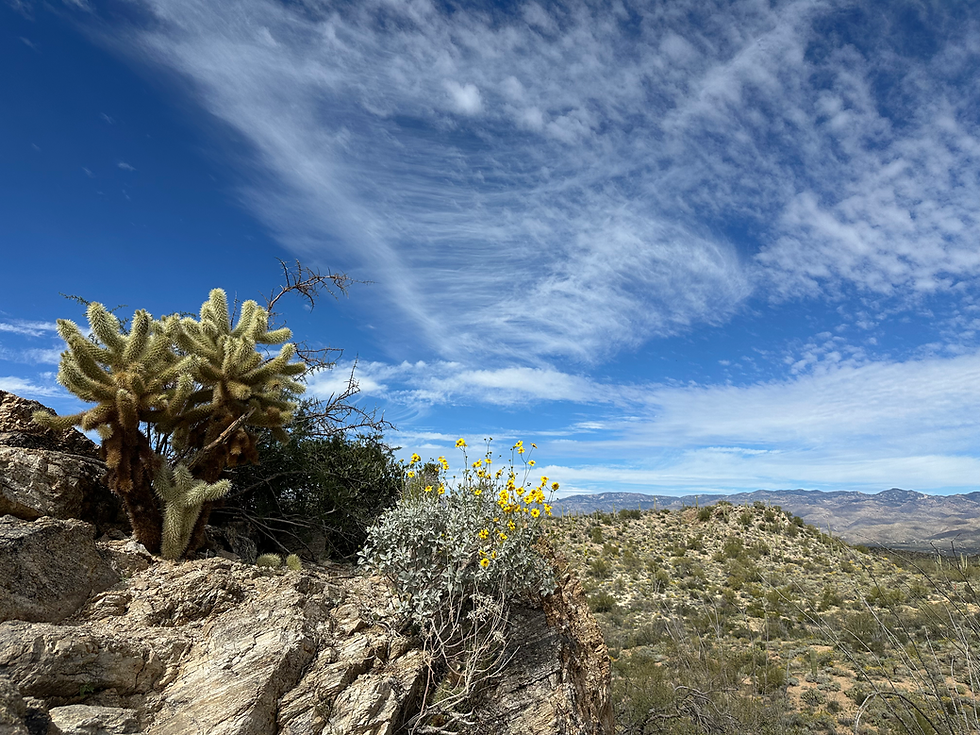
The cholla cactuses were both mine and my mom’s favorites. There are a bunch of different types, and each is super interesting and cute-looking. The Pencil and Buckhorn chollas are long and thin, the Chainfruit is a little more bulbous, and the Teddy Bear Cholla - our favorite - has so many thick and yellow prickles that it looks fuzzy.
Palo Verde
I fell in love with Arizona's state tree, the Palo Verde. These trees are totally green, bark and all, thanks to chlorophyll everywhere, which allows them to continue photosynthesizing even if they lose their leaves during a drought. This makes them super drought-resistant, as they would need to be to survive in this climate.

Ocotillo, Mesquite, and Ironwood
I really enjoyed these other weird plants and trees that grow in the desert. Ocotillo can have red flowers on it, although we didn't see too many of those this time of year. Mesquite trees are cool because they are nurse trees for the Saguaro cactuses, protecting them from direct sunlight, frost, and herbivores. This is why you will often see a cactus caught up in a mesquite tree: I first thought the mesquite grew around the cactus, but it's quite the opposite! Finally, ironwood is super dense, hence the name, due to the lack of water, and this makes it very durable and valuable.
Prickly Pear
Finally, a crowd favorite that is popular all across the Southwest is, of course, the prickly pear cactus. This iconic cactus has flat, pancake-like pads (as they are called) that are edible when cooked. They also bear edible fruit that is sweet and quite colorful.

The Desert Life Cycle
Aside from all the helpful placards, one of the other things I enjoy most about national parks generally is that they do not keep them "clean" the same way you would experience in a botanical garden. The parks are maintained but not overly manicured. Nature is left to continue in its natural state, so you can see the whole ecology and learn a lot.
For example, a lot of the cactuses look a bit chewed up because, as we learned, birds will carve out a little hole for themselves to use as shelter. This doesn't harm the cactus because it forms a callus, which saves it from rot or pests. Then, when the cactus dies, small ground animals can use the same holes for shelter. Even when fully desicated by the sun (which looks really cool, by the way - you can see the entire vasculature), the cactus shell continues to provide shade and shelter to small animals.
Accessing the Valley View Overlook Trail
The Valley View Overlook Trail has a nice-sized parking lot (compared to other stops in Saguaro National Park) just a short drive from the entrance to the Bajada Loop Drive. However, because this is also the trailhead for the Wild Dog Trail and an entrance point to the Bajada Wash Trail, this parking lot does tend to fill up. If you can get a spot, though, I do highly recommend taking the short walk down for an educational hike!